Monday, September 10, 2012

And then there were five... a 2-day jaunt through the Northern Pemigewasset wilderness

The weather for the weekend of September 1st and 2nd looked great; 70s in the day, low 50s at night - great for hiking and sleeping outside. So, there was a 2-day backpack I had in mind that would allow me to bag a couple of peaks I needed along the rim of the Northern Pemigewasset Wilderness, Galehead and North Twin. John and I had taken this particular route last year, so I was familiar with it, at least most of it.

My route for the weekend would run up to Mt. Garfield, from the Gale River Road, off of Rt. 3. The Garfield trail connects to the AT, and from there I'd take the AT east, stay at the Garfield Ridge campsite, and then the next day continue to Galehead, and then to South Twin. From there, split with the AT and hike to North Twin, and back out. The total mileage for the weekend would be just over 15 miles.

Now, if you look at a map, you'll notice that my end spot is pretty far away from my beginning. If I was there with another person, we could spot a car on either end, but I was alone. But not to worry... I spotted my bike my end point, and then drove back to the start. Simple! But on the was back from spotting my bike, driving 60 MPH down Rt. 3, I realized just how far the bike ride back would be. And, after completing a 10-mile hike that day over some very difficult terrain. And, as it turns out, in not-so-great weather after all.

Thruhikers emerging onto the Garfield summit
I took the Garfield Ridge trail in more so because I wanted to do an overnight at Garfield Ridge, and other than Galehead Hut there wasn't much in the way of sites. And, John and I stayed there last year and it's a very cool little site. The 4.8 Garfield Trail is fairly inconsequential; a steady uphill slog through the woods, with very few views in any direction. I saw a lot of people pass me going the opposite way; I didn't actually see anyone going up like I was. There were lots of cars in the lot and along the road on the trailhead, I'm guessing a lot of these were folks doing a dayhike. I'd gotten a pretty late start - around 2 PM I think - but I only had a five mile hike the first day. After reaching the trail junction (right goes to Georgia, left goes to Maine...) I headed down a very steep trail to the campsite. I figured it was wise to get there early and claim a spot - I was counting on sleeping in the shelter but had my tarp in case. Turns out, they'd rebuilt the shelter recently, and it was a beauty. Click here to read about the new shelter. I inflated my Thermarest and stuck it in the far corner, under the loft. I laid out my sleeping bag, and changed into a dry shirt. A few people were drifting in, but there was plenty of room, as it was still pretty early. I threw a few essentials into my pack (water, extra layer, first aid kit, map, whistle, etc.) and traced my steps back up the trail to go to the summit of Garfield.

I'd gone up Garfield last summer but it was socked in, and I heard the views were great, so even thought I had already "bagged" the peak, I couldn't be this close and not go up on what was a clear, beautiful day with only a few clouds in the sky. It was a quick but steep climb, and I came out onto the vista.

Like so many of these gorgeous summits, about all you can manage to utter is "Oh, wow...", as your breathing catches up and your mind reels at the vast, wild beauty. I sat near the foundation of an old fire tower with a couple of other people, the sun and the summit breeze felt great, and began to dry the sweat I'd accumulated on the quick climb up. Three young NOBO (north-bound) thruhikers and their dog soon joined, and we chatted about their adventures, gear, and other things hikers chat about. They said their daily mileage had plummeted since hitting the White Mountains, a common occurrence. But they couldn't complain, after all; it's some of the toughest going on the whole AT, but also some of the most scenic. Everyone who comes through these mountains seems to understand what a special place it really is.

summit of Garfield
You never really can stay at these places as long as you want; at some point you have to go back down. So I did, wishing happy trails to the epic hikers, and returned to the shelter. I cooked dinner and had some great conversation with the ever-increasing number of visitors, most going the opposite way than me. We shared stories of the trail, and our plans for the rest of the long weekend. The caretaker showed up, and when he saw my form that listed Somerville as my home, we quickly discovered a connection: his sister worked at my neighborhood bar, and I know her pretty well. Small world! He was a very funny and informative guy, who seemed to be an endless font of knowledge concerning all things mountain-related, especially skiing and other winter sports, of which I know almost nothing. A few of us spent the hours of waning light and into the darkness at a little outcropping near the entrance of the site, with a beautiful view of the ridge extending out to Galehead and the Twin Range. A Blue Moon hung in the clear sky, and a shooting star streaked across it, and the caretaker pointed out a tiny glint of light on the side on the ridge in the far distance. "That's Galehead hut. They usually turn the light out right at 9." and explained that oftentimes he'd sit and for some time for it to go off. It's funny, it seems incredibly boring or pointless to sit and stare at a tiny light on a mountain miles away, waiting for the crew to extinguish it after feeding and putting all their guest to bed, but we all knew we'd do the same. Things like that make sense in the mountains.

My mom sent me a card recently with a quote from Thoreau on it. "The moment my legs begin to move, my thoughts begin to flow." I felt like that much of the next day, after sleeping quite soundly and waking to a light, cold drizzle. I got my stuff together, got my food out of the steel bear box, and munched on a bagel and cream cheese I got on the way up. Everyone was milling about, waiting for the rain to stop, but it didn't seem to be letting up. It also wasn't very heavy, so I decided to get going. I stopped at the spring nearby, filled up my water bladder (I treated with tablets), and hit the AT, hiking east. It was only a couple of miles to Galehead hut, where I could get more water, so I didn't take any more than I needed. Water is heavy, after all. The hike down from the site was arduous and steep, and slick from the rain. I moved slowly, taking great care. It eventually evened out, and my thoughts were definitely flowing.

I think a lot about nature on the trail, naturally, and why it is people seem so keen on being out here in these mountains. I'm not a religious person at all, but at the top of a mountain, I have overwhelming emotional responses that some might consider spiritual; I'd agree in the sense that it's the way, as a child, I always thought I should feel in church, about god; but those feelings never came. But it's not worship for me - for it to be worship would entail believing in a diety or force that can be, and know it's being, worshipped. This is clearly not what nature is, at least I have no reason to believe that's so. With nature it's more about communing, a word I like very much in this context. We are all made of the same stuff that nature is, we are literally, atomically, the same, constructed from billions-year-old stardust. To worship nature would be to worship ourselves, which seems pretty ridiculous; to commune with nature is to commune with ourselves, our own minds and consciousnesses, which seems like a very good thing to do. With every mile, every sore foot, every sunburn, we grow to know ourselves more and more. Nature doesn't care if we're there or not, but that doesn't make the experiences we have within ourselves to be any less powerful. I think just the genders we use to think about these concepts - Mother nature, Father god - is telling about their roles in our lives. In some broad cultural sense, mothers nurture and teach compassion and communication; fathers control and impose discipline and punishment.

thruhikers on South Twin
I arrived at the Galehead hut chilly and wet, my rain jacket seemingly making me even more so due to it's ability to trap sweat in and yet somehow fail to repel water - Marmot, I love my Sawtooth sleeping bag but I'm not impressed with your Precip jacket. Time to go to REI and I fear shell out some big bucks for rain gear that actually delivers. I ditched my pack on the porch and headed inside to try to dry off and warm up. I read a book for a while about the history of the AMC huts, had some hot cocoa and a chocolate chip bar baked by the hut "croo", avoiding going back out in the cold drizzle. But, you gotta keep moving; so after a while I make the quick trip up to Galehead Mountain - finally, bagging a peak on this trip I needed - which was a bit disappointing; no views but a big pile of rocks on the summit. It's like Owl's Head all over again! I came back down to the hut, and ran into the thruhikers again. They hadn't stayed at the site, but opted to camp in the woods a few miles down the trail, probably to avoid the $8 a night site fee. Thruhikers are cheap, but you have to be, if you're taking months off to walk 2200 miles with no income. They were carrying on, loudly joking with each other in faux Jamaican accents. The thruhikers I meet in the Whites always seem a little crazy - I think you have to be to undertake such a journey anyway, but by the time they get here, they've been on the trail a loooong time.

scattered clouds on S. Twin
After filling up my water - all of it, my 2L bladder and 1L bottle since there wouldn't be another chance till I was up and over both South and North Twin - I headed up the .8 miles to the summit of South Twin. I'd done this trail before, and remembered that it was quite steep. I was trying to limit my sweating, since most all my clothes were now wet, and it was rainy and in the 50's. Hypothermia is a concern in those conditions, and mind you, it's still technically summer. This is why you don't take hiking in these mountains lightly, and always have your essentials. In my effort to control my perspiration, I found myself hiking in a way that actually made the mountain quite a bit easier to tackle. I tried to control my movements, hike steady and slow and strong, one foot in front of another. All day I'd felt like my stride was little more that a controlled stagger, I'd been lurchy and stumbly, and it was taking it's toll on my mood. Now, having made small adjustments to my pace and rhythm, I was feeling much better about things, and this steadiness followed me through to the end of the day. I will keep this in mind from now on.

I was glad to read the summit of South Twin, though it was pretty foggy. Quite beautiful, though, anyway; the clouds were blowing by and trying to burn off; the sun would peer out and patches of blue sky presented themselves here and there. It was actually really cool to see views open up, like looking outside through a drifting window, and I was hoping the sun would soon come out at last.

Happy trails leading to N. Twin
I bid a final farewell to the gang of thruhikers, as they would continue on the Appalachian Trail and I was hiking out to the north, out the North Twin trail, back to Rt. 3. I never caught their trail names, but I bet they'll make it to Mt. Katahdin no problem. Finally, travelling down in the col between the Twins, the sun finally came out! It felt really great to finally have dry, sunny weather after being chilly and damp all day. I started to dry out a bit. This might have been my favorite part of the actual hike - other than the summits. It was easy going, the forest was diverse and interesting, song birds were singing, and I was warm. After a short climb back up, I saw the sign pointing me down the North Twin trail, and one pointing to the overlook. I dropped my pack and headed out to the vista.

Garfield was great; North Twin is spectacular. Words can't do it justice, pictures are laughably inadequate. For the first time since sunrise on Mt. Bond, I was actually brought to tears by the sight. The Pemigewasset Wilderness was laid out in all its massive splendor, peak after peak, rolling mountains carpeted with countless trees of late-summer, sun-baked green. The clouds were rolling away. What I think was the warbling of a spruce grouse drifted in from the brush. I was alone, on top of the world. It was marvelous.

overlook on N. Twin
The North Twin trail was long and a steep climb down; I was very glad I wasn't walking up it. About 2 1/2 hours later, I finally made it to the trailhead where I'd spotted my bike. A few exhausted hikers laid around in the sun, and I considered joining them but I wanted to keep the momentum going: I still had to ride my bike a few miles down the road, with a full pack.I drank the remainder of my water and started riding. It was tough, especially going down the gravel roads that connect to Rt. 3. By the end, when I was nearing my car, I had to get off and walk it - I had nothing left.

As I ambled over the last couple of miles through the forest, I had thoughts that I only have when my feet beat a path across this well-worn ground. Revelations and insights come and go like a remote AM signal, insights that many have likely had on this very same trail. Sometimes the signal fades, as if in a tunnel, and sometimes you lose it altogether. But when it does come in loud and clear - and music fills your ears - you remember.

What I should have brought that I didn't have: another layer, preferably a long sleeve Smartwool job. When I wasn't sweating I was getting rained on, and a dry layer would have been welcome. • A rain jacket that actually works...

Luxury item: Thermarest Pillow. A birthday gift, and wow, it's comfy. Usually cram clothes into a stuff sack for a pillow but it doesn't work well. I strapped this to the outside of my pack and credit it (along with my Thermarest Prolite and Sawtooth bag) for getting a better-than-average night's sleep. Might not carry it for a long trip, due to its weight, but for an overnight backpack or car camping, I'll deal with it for a night's sleep almost as comfortable as at home.

Glad I had: Extra socks, as usual. • Light Warm hat; small synthetic bike hat with fleece liner. • Down Jacket; wore at camp when it got dark and cooler, in the morning under my rain jacket before I started hiking. • MSR Pocket Rocket stove: While others were futzing around with iso stoves that have to be assembled like a puzzle or boiling water slightly faster with a Jet Boil the size of a rocket engine, my trusty, lightweight Pocket Rocket boiled water for dinner almost as quick, even on my cookpot without a lid (note: get a cookpot with a lid). • Patagonia Capilene long top & bottom. Haven't used them til now, since it's cooling off; they're warm, dry quickly, light and comfy.

Forgot: Coffee. D'oh!

Sunday, August 26, 2012

Owl's Head & Hale

I figured it was about time to tackle Owl's Head (4025'), one of the more remote 4000 footers in the White Mountains. Situated in the Pemigewasset Wilderness west of Franconia Ridge, Owl's Head is long a thorn in the side of peakbaggers attempting to accumulate all the 4k peaks. Owl's Head is often left til the end of the list for a lot of hikers, due to the fact that the easiest route to it, and back out, is about 18 miles (maybe more like 19 with the additional mileage to the "new" summit), and there are absolutely no views from the top. There are many things to like about this little mountain, however.

I approached the Lincoln Woods from a large parking area off the Kanc at about 7:45 AM on August 19th. It's nice, with restroom facilities, a visitor center, and informational kiosks. It's the most popular area for accessing the Pemigewasset Wilderness, with trails leading to Franconia Ridge, Owl's Head, and the Bonds, among others. After finishing up the 4000 footers, I'd love to attempt a Pemi Loop, a usually-multi-day hike circling most of the Pemi Wilderness and hitting lots of peaks. I crossed a large 160' suspension bridge that crosses the Pemigewasset river and hiked north at a quick tempo, due to the fact that the Lincoln Woods trail takes the route of an old logging road. The path is very flat, smooth, and wide, and I made great time along here. I think this is why a one-day trip to Owl's Head is done so frequently; it's an 18 mile day but so much of it is on easy terrain, it can be done in a reasonable amount of time. My time for the whole trip was about 10 hours. Also, if you start later in the day or are hiking when the sun sets early, this flat, wide path could be easily taken out in the waning hours of light, or in the dark, with a headlamp.

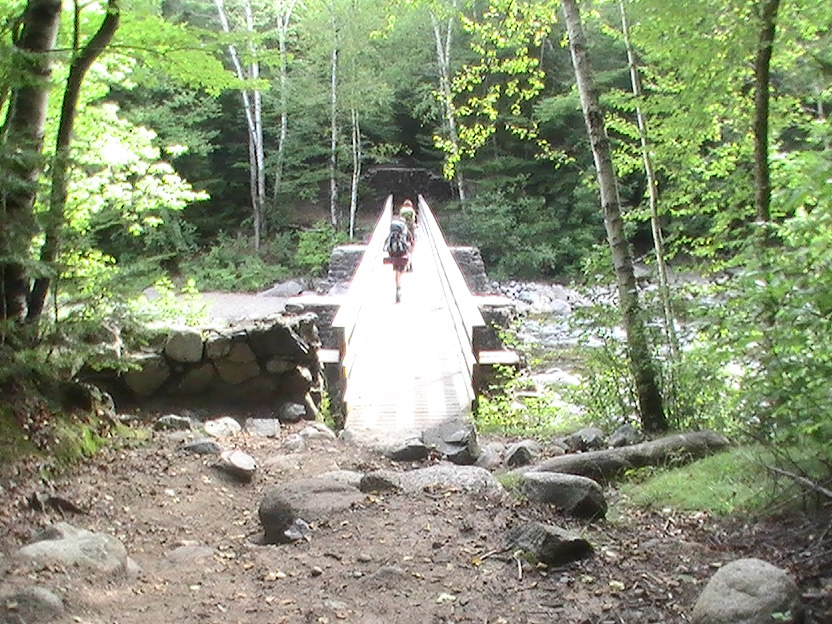
hikers crossing a bridge
I passed some other interesting landmarks, like a stone foundation of a building, and another large bridge, before the trail hits the Franconia Brook Trail, and then turns sharply west onto the Lincoln Brook trail. The trail becomes a bit rougher at this point, and starts to angle up a bit. But still fairly easy in relation to many trails in the Whites. There were a couple of challenging brook crossings here over Lincoln Brook. The White Mountain Guide warns to be very careful during high water or the spring melt, and I can see why. We hadn't had much rain recently and the crossings were still not easy. On one, rock-hopping wasn't an option, and I took of my shoes and waded across the brook with bare feet. No complaints; the cold water felt great. Around here I met a couple of guys who'd camped out around Owl's Head and were making a 2-day trip of it. I asked where they camped (there aren't any official sites in this area) and they said something to the effect of "We threw our pads on the ground and slept!" Fair enough. The powers-that-be discourage "stealth camping", I think to minimize effects of repeated camping on delicate foliage, and also to encourage people to stay at legit sites in order to raise revenue with the site fees. They also told me the slide was dry, and in good condition.
The slide on Owl's Head is definitely the most interesting part of the day. After hiking for 8 miles over rather unchallenging terrain just to get to the mountain, you're hit with a 1500 foot climb in a mile, up the rocky, rough, and steep western slide. A little cairn in the middle of the trail, 3.4 miles after turning onto Lincoln Brook trail, shows the way up. It's an unmaintained spur, so it's kind of hard to spot. But turn right at the rather conspicuous pile of rocks, and you'll be okay.

I was a bit nervous about the slide, but it was actually quite fun. Hard, but fun. There are few places that are actually treacherous; even if you fell you'd likely just slide a few feet back down and maybe get scraped up. A couple of dangerous-looking cliffs were adjacent to the trail, but easily avoided. I was hiking at this point with a very friendly father-son duo, Henry and Jeff. Henry was trying to finish the 4000 footers before his eleventh birthday! He was a strong little hiker, and didn't complain once, and his dad and I had a lot of welcome conversation.

Add caption
I stashed my poles, and we climbed up the steep grade, rocks tumbling down below our feet, trying to find footing that would propel us up and not have us sliding back down. Most of the time you're touching the ground in front of you, finding handholds in the rock and trees along the exposed, sun-scorched trail, and looking for little cairns that guide the way. The Guide recommends staying to the right on the ascent and decent, due to the stability of the rock and availability of handholds. After getting up into some elevation, we looked behind us and had the first view of the massive Franconia Ridge, from a perspective I've never seen. It was quite beautiful. The day was hot and clear, and it was about noon.

After a while we cleared the exposed part of the slide and ducked into the woods, still climbing at a steep incline, but at least now sheltered from the midday sun. At this point were were all very tired and now devoid of views, it turned into a full-fledged slog. Every bend, we'd say surely this is it! But no... more climbing. After about 15 minutes of this the trail finally leveled out, and we approached the "old" summit.

There's an old summit and a new summit. The old summit was the one they used to believe to be the highest point on Owl's Head, but some busybody with a GPS found that there is actually a higher spot. All these trails are officially unmaintained by the AMC (still haven't gotten a clear answer as to why...) but they are pretty well trampled, due to its inclusion on THE LIST. Many say no hiker with all his marbles would visit this mountain, with its long approach, super-steep slide, and viewless summit, had it not been included in the 48. Apparently the AMC doesn't require those who climbed Owl's Head before the new summit was discovered to go back and get the new summit, but many do anyway. So, after passing the old summit, we followed a maze of cowpaths and eventually got to the new sucker, where a large cairn has been built in a nondescript wooded area. I think so many paths now exist because everyone just kind of finds their own way, and creates several rough paths to the true summit. What happens when no official path is established.

uneventful summit
After getting pictures and resting for a few, we headed back down. The hike down the slide was a bit more unsettling than going up, but it was definitely easier. We enjoyed the views all over again, and eventually got back down to Lincoln Brook trail, back to flat ground! Now, another 8 miles out. I changed my socks, getting into a comfy, dry pair before the long haul, and ate some lunch. We contemplated taking a bushwack that apparently connects Lincoln Brook and Black Pond trail, shaving a couple of miles off the return trip, but decided against it. At one point, cruising down the trail, Jeff and I were talking and suddenly WHAM! I rammed my head full-tilt into a huge tree that had fallen over the path and rested about 5 1/2 feet about the trail, that I should have ducked under. But my head was down, I was hiking fast, and I had a brimmed hat on, so somehow I just didn't see it. Ouch. Not recommended. Jeff asked if I was okay, and I was, just a bit embarrassed and left with an aching neck.

We waded across the brooks again, the ice-cold water welcome on my aching feet, and at this point I hiked ahead and told Jeff and Henry I'd see them at the trailhead. My pace was slightly faster than theirs - but not by much - and I just wanted to shift to a higher gear and get this day done with. After seeing everything in reverse, I found myself again on the wide, flat Lincoln Woods Trail, and began to see families and dayhikers taking an afternoon jaunt. Eventually the suspension bridge presented itself, and I skirted down the side down to the river and stuck my feet in again. Ahhh. Nice way to end a hike. It was about 6. Henry and Jeff walked across the bridge a few minutes later, and we exchanged pleasantries and said goodbye. Hikers are great folks.

I got back to EmmyVue and got into my Birkenstocks and a dry shirt before driving a short way down the Kanc to Big Rock, where I pitched my Coleman tent at the same spot John and I stayed at a couple of weeks before. I paid the fee, got some firewood from the caretaker, and then headed into Lincoln to the Common Man, a great little bar/grille/ski lodge, where I met Dana and her dog Gretel. Dana and I had a couple of beers and some food while Gretel dozed in the car, and after a while headed back to Big Rock where we built a fire. Before long we turned in; I was bushed.

Gretel, looking for large land mammals to terrorize
The next morning we head to Mt. Hale, a 4054' foot mountain up near Zealand Notch. We took Zealand Road to the Hale Brook trailhead, and the three of us started up. The climb up this trail is a lot like Tecumseh; very lush, not too steep, but a challengingly consistent grade. Gretel, as usual, would bound off into the woods, splashing into puddles and brooks and tearing through the underbrush, occasionally looked back and me and Dana as if to say "What's taking you guys so long??"

At one point, out of the corner of my eye, I saw a big black creature tear down the mountain, about 15 feet to the left of the trail, obscured by trees. I assumed it was Gretel but simultaneously was surprised at the much-louder-than-normal noise she made crashing through the thickets and the speed at which she ran. I looked ahead, and Dana, with a look of surprise and concern on her face said "That was a bear!" At first I thought she was kidding, but then I saw Gretel far up the trail, looking down at us, a bit baffled. She'd apparently startled a small black bear, who then took off like a shot back down the mountain. It was exciting, my first black bear encounter! Even though all I saw was a black streak, it's a first. I really couldn't believe how fast it moved. We proceeded with caution.

About halfway up the Hale Brook Trail the grade steepened, and a couple of little switchbacks carried us around toward the summit, positioned to our left. It wasn't extreme but I was dragging, maybe due to the long day I had up Owl's Head. Of course Dana barely broke a sweat (:P). The weather was clear and warm, a great day for hiking. Eventually the trail opened to a partial view out toward Tom, Field, and Willey, and after a couple more minutes, we found the summit. It was a small clearing surrounded by trees, not much view, but with a huge pile of rocks, the top of which granted a limited view of the surrounding mountains. Though mostly viewless, it was a very nice open summit; the sky was bright blue and the midday sun was warm, a nice change of pace from the humid woods we'd been hiking in. We had some lunch and lingered on the summit, resting and chatting. Gretel enjoyed licking the inside of my tuna-pouch quite clean, and we tried to get her to sit still for a photo on top of the rocks. Almost.

Atop the Hale Summit rockpile
We moved on, starting down the Lend-a-Hand trail, toward Zealand Hut. This is actually one of the nicest trails I've been on in the Whites, fairly easy and passing through swampy marshes, fields of grass and mossy trees, and beautiful, rocky forests. There seemed to always be something interesting to look at. One of the cooler things was a very small venus fly-trap plant growing near some water; almost too tiny to even see. I'd imagine the bugs it eats are actually too tiny to see. The biodiversity in these woods seems boundless, and never gets boring.

We eventually got down to Zealand falls, and took a break at the top, where Gretel found a natural waterslide down into a basin, which she rode down a couple of times, her legs flailing around. Zealand falls is an incredible natural occurance, and the mind reels at the infinite number of shapes water, given enough time, can carve from rock. Ice cold water cascades down from shelves of varying sizes, creating clear basins and pouring down again, over and over. Swaths of smooth, hot granite, baked in the sun, provide excellent places to lounge and lose track of time, contemplating these ancient falls.

We hiked down to the hut, where we took another break and leisurely watched the visitors come and go. A northbound thruhiker shared his adventures, and a somewhat socially awkward AMC guy was inviting folks to look at sunspots through a telescope. Gretel tried to infiltrate the hut, probably smelling something delicious inside, but we intercepted her. After taking in the beautiful view of Zealand Notch opening before us for a few minutes, we hiked down a short but steep rocky descent from the hut and tramped north on the fairly easy Zealand Trail. Easy, but quite scenic, with rustic bridges over ponds, well-worn paths, and nice views of Mt. Hale on the left and many peaks to the right. After reentering the woods for a while, we eventually hit the parking area. The trek down Zealand Trail seemed an awful lot shorter this time than when I did it coming back from the Bonds. Maybe because my pack was lighter, or I hadn't hiked as many miles that day, or because of conditioning, I'm not sure.

We walked back down the road for about a mile to get back to the car. Our mileage for the day was about 8.6 miles, and other than the Hale Brook Trail, was relatively easy; and the hard stuff was out of the way pretty quick, leaving us to enjoy the day on some of the nicest trails in the area. No super-amazing views, but a side trip up to Zeacliff would be a fantastic addition to this hike. I'll definitely recommend this one to people looking for a nice tour of the Zealand area.

Another beautiful, challenging, and memorable weekend in the White Mountains, with big miles and great conversation.

Thursday, August 16, 2012

Tecumseh and Carrigain

Over the weekend of July 28th and 29th, my buddy John and I went up North to do a little camping and hiking. We did a long hike last September, when I summited my first 4000 footers, and we both needed Tecumseh and Carrigain for our list. So we headed up early on Saturday, accompanied by The Best Dog In The World, Gretel. Gretel's human, Dana, was working all weekend and asked if Gretel could come with us, and I'm glad she did.

We drove up 93, keeping an eye on the weather, and headed down the Kanc to secure a campsite. We found one at Big Rock, and I set up my Coleman tent, to secure the space (these spots are first-come-first-serve, and on the weekends in the summer fill up quick. It's a good idea to stake one out early if possible), we paid our 20 bucks at the self-pay station, and headed back down to Tripoli Road (one exit south off 93 from the Kanc) to find our trailhead.

Summit of Mt. Tecumseh
Last time I was on Tripoli Road was to go to the trailhead for my Oceolas hike. We went a bit further this time, and turned off onto a gravel lot to access the (trailhead name?) to hike up Mt. Tecumseh. On the way down Tripoli I saw a sketchy character walking the opposite way, who looked very unlike a hiker, walking along the road looking into parked cars. I think he actually tried to open one. Break-ins at trailheads are common, and I hoped my car wouldn't be his next victim. But we were on a somewhat secluded lot, off the road, which I wasn't sure was better or worse.

Tecumseh is a pretty no-nonsense mountain. It is the smallest of the 4000 footers, and the trail pretty much goes straight up, at a consistent grade, to a sub-summit, then down a bit into a small valley, and up to the true summit. Not terribly taxing (which was a bit surprising because the guy I met on the Hancocks said it was deceptively difficult...maybe he used a different approach). But the views at the summit were very nice. This would be a great dayhike for beginner hikers wanting to get a taste of the mountains, especially those coming up from the south. It's pretty much a 2 hour drive from Boston, it's a truly beautiful trail, resplendent with lush green in summer and giving off a very Hobbit-y vibe, John and I decided, with great views from the top. And with about a 6 mile round trip hike up and down, it's a pretty quick dayhike, you could be back home before dark.

I hadn't done much hiking with dogs, and it was quite fun. Gretel would bound off into the woods after a critter, crash into brooks with abandon, leaping like a deer through the brush off in the forest. I was impressed at her abiliby to tear through thickets and water and rock with little effort or resistance, almost like she was made for this terrain. She didn't ever seem to tire (at least on the first day!)

Me and Gretel on Tecumseh
We ate some lunch at the summit and enjoyed the view, and Gretel ran to a couple happily expecting them to share their lunch with her. The man suddenly said to me, "Are you a Redditor?" Reddit is an online community of folks who post photos, links, stories, and other tidbits and then comment and vote on the content. "Yeah!" I replied, a bit taken aback. He subscribes to the "Camping and hiking" community on that page, and had seen the pictures I posted of my Presidential Traverse the weekend before, and recognized me. Small world! We talked for a bit; turns out he'd commented on my photo album, saying he and his girlfriend were going up Washington this weekend. Turns out they didn't, and came to Tecumseh instead. I felt a tiny bit famous.

I contemplated the vast difference between last weekend's Traverse and today's hike. One, an epic 20-mile 9000-foot-gain journey over the highest terrain (and up the highest peak in the Whites, and the entire Northeast) and today's hike, a quick jaunt up the smallest 4000 footer of them all. Starkly different, but both very enjoyable in their own ways.

Camping at Big Rock on the Kanc
We got back to the car in the early afternoon and headed back up to the Kanc. Big grey clouds were starting to roll in. After a quick stop at that awesome roast beef place in Lincoln (check it out) and at an outdoor supply place, just to poke around, we went to our site at Big Rock. It was starting to rain. We rigged up my Equinox tarp over the picnic table, made tea and had some more food, and chit chatted for a few hours. The rain was coming down pretty hard at times, and our attempt to make a fire in the pit was not successful. After the sun set, we turned in, John in his hammock and me and Gretel in my Coleman. The tent kept us pretty dry through the night, and it rained pretty steadily for most of it. I slept pretty well, considering I was snuggling with a stinky wet dog, and we were up at around 8.

AMC Highland Center - photo from mtwashingtonvalley.org
John wasn't feeling up to another day of hiking, so we decided that I'd drop him at the AMC Highland center and Gretel and I would go hike Mt. Carrigain. We drove east down the Kanc and took Bear Notch Road to 302, and headed up toward the Highland Center. On the way up we saw that Sawyer River Road, the road that would bring me to Carrigain's trailhead, is closed. At the Highland Center they told us it had been closed ever since Irene blew through, almost a year before, and that the only way down it was to walk. After some deliberation I decided to go for it, even though the road walk would add time to the hike. I left John and headed back down, parked at the top of the road, and started hiking in with Gretel at about 10:30.

The road didn't look too bad, some wash outs, but it looked as if it could be driven on. Perhaps it's unstable in parts with the weight of a car. I hope they can get it fixed up soon. The road walk took almost exactly 30 minutes, and I came across the trailhead for the Signal Ridge trail, that heads straight to the summit of Mt. Carrigain. The first couple of miles were quite easy, a flat trail that skirts Whiteface Brook. Still a lot of blow-downs and storm damage that has yet to be addressed, but pretty easy going. I made great time on this part. After the junction with the Carrigain Notch Trail, things started to get tougher. After a while, it was a straight-up slog that seemed to go on forever. It was very humid, the rain we'd gotten the day before seemed to linger, making everything wet and slick. Gretel bounded off the path now and then, after god knows what. I was completely soaked, and I couldn't even tell if it was sweat or if I was just soaking up ambient moisture like a sponge. I passed a couple coming down, and they said the top was basically inside a giant cloud. Great. They also said they'd heard thunderstorms might be coming through. This made me a little nervous, but we pressed on.

Signal Ridge trail kicked my ass
The trees started getting scrubby, and the fog got thicker and thicker. The mist that hung over the trail was unsettling, and visibility was getting worse. We finally got up to a clearing, but views were non-existent. I'm not even sure if it were the summit; I know there's supposed to be a tower somewhere but I didn't see it, either because I was at a false summit or the visibility was so poor that it was hidden in the clouds. It started to rain at this point, and I called it - we headed back down. The hike down was long and hard, and eventually we the rain sunsided and we emerged from the cloud and it was sunny again. Strange how quickly the conditions can change in the mountains. We made it back to the trailhead and Gretel and I horsed around for awhile before taking a quick break. I took my shoes off and ate a snack and drank water before walking the road again. I realized I hadn't really taken a break the whole time, and had had little to eat. Not the way I like to do things, but the weather and the rough terrain distracted me from taking an opportunity to take breaks and eat. I was a bit disheartened by this hike; due to the fact that I am unclear if I even was on the summit, and that apparently Carrigain has amazing views on clear days, I'll be doing this one again. Ah well. It was a good workout, anyway, and Gretel and I had fun. It was a 10 mile hike and took 5 hours. The road walk added another hour to the total time.
"why are you doing this to me?"

We made it back to the car and I was so wet I felt like I'd jumped in a lake. I put on some dry clothes and loaded Gretel up. She collapsed in the seat, immobile. Tired pup. We met John back at the Highland Center, where I was delighted that a barbeque buffet was happening on the patio. We paid for our meal tickets and I got a cheeseburger, potato salad, ribs, sausage, cornbread, and a beer. I ate every bite, and I felt a lot better. We sat at a table with some folks - a mom and her two sons - who were visiting from New York. The younger son had volunteered on the A-Z Trail during the summer, and the older son was planning a thru-hike of the Vermont Long Trail. They were extremely friendly and John and I recommended hikes for them to do. The hiker community, whether moms and sons on weekend trips, or scrawny, bearded thru-hikers with names like Furbag or Teflon, is wonderfully friendly and open, and I enjoy their company a great deal.

After stuffing ourselves and bidding our new friends adeui (and purchasing a new book) we headed to the Sugerloaf II campsite where we grabbed a lovely campsite above the Ammonoosuc River. The caretakers were friendly, warning us of bears while they collected our fee. They even said to put the food in the car and cover it, because if a bear sees food in your car he'll peel the thing open like a tin can to get at it. I'd never heard about this behavior before, I thought they went by sense of smell. I get a bear warning so frequently, but I still haven't seen one! I wasn't worried, bears rarely will come to a site with a dog; Gretel will protect us. John pitched his hammock (or as he calls it, his "bear pinata" and I pitched my tent - we rigged the tarp again over the table, in case of rain, but it never came. We built a nice campfire and I drank a couple of beers we'd picked up on the way to the site. We had a great view of the sunset and the night was great, with a little nip in the air. After sitting around the fire for a while Gretel and I turned in - we were both beat. Other than waking up once to Gretel growling at something outside the tent - this was disconcerting - I slept great.

Camp at Sugarloaf II near the Ammonoosuc River
I didn't like what happened on Carrigain, and I'm looking foward to going up it again on a nice day. But it was a very enjoyable weekend of hiking, camping, and fellowship with nature and friends, old and new.

What I brought: Everything. For car camping I usually just throw everything into EmmyVue Harris and go. For the actual hiking, it was my standard fare, but with very few warm clothes and lots of water, due to the heat and humidity. I probably could have taken my little Flash 18 pack up Tecumseh, it was such a short hike. For the quickie dayhikes I have left, I might do that.

What I was glad I had: My Equinox Tarp. though I still haven't used it as a primary shelter, I like carrying it. It came in handy at camp the night it rained, though I might pick up a much larger, cheap blue tarp at a hardware store for car camping. My silnylon tarp is only 6' x 8' and left us susceptible to some residual rain splatter here and there, but when weight isn't an issue, the bigger the tarp the better. I'll probably pick one up and just leave it in the car.

Thursday, July 26, 2012

An Epic Day: The Presidential Traverse

The wild, rocky Northern Presidentials


My buddy John and I summited Pierce, Eisenhower, and Washington last year - but since we got a ride down from the big boy, they didn't "count" as peaks - according to the AMC. So, to claim them as a "climbed" 4000-footer, I'd have to tackle these suckers again. So, I figured, why not do them all?

The mountains that lay South of Mt. Washington are known as the Southern Presidentials. Monroe, Eisenhower, Pierce, and Jackson. Also included is "Little Monroe", Webster, and other smaller sub-peaks. Jackson is sometimes included in a "Presi Traverse", but we didn't hit it this time. These mountains are all above treeline, and are rocky and exposed, but nothing compared to the Northern Presidentials, which rise up north of Washington. These mountains are truly the most wild and otherworldly in the region; sometimes it's almost as if you're traversing an alien planet; fields of scree and lichen, wild winds, erratic weather, and steep, craggy cliffs. But gorgeous; just absolutely breathtakingly beautiful. The official 4000 footers in the Northern Presidentials are Madison, Adams, and Jefferson (we also summited Mt. Clay). Add Washington in as the mid-point, and we're climbing the tallest (well, 5 of the tallest, Eisenhower and Piece come in a bit down the list), roughest mountains in the Whites, over 20 miles, with 9000 feet of elevation gain... in a day. Yeah, it sounds a bit crazy.

cairns made of quartz on the trail
After spotting a car at Crawford Notch near the AMC's Highland Center, we made camp at the Crawford Notch campground and were up before the sun. We hit the trail at Appalachia Trailhead on Route 2 - the northern terminus of the Presidential Range - at about 5:15, Sunday, July 22nd, and hiked south. The woods were muggy and full of toads as we climbed toward Mt. Madison; by the time we hit treeline, the morning mist was burning off and a beautiful day was presenting itself. We carefully followed the cairns - piles of rocks that mark the trail - over a seemingly unending upward expanse of large rocks. Constant attention must be paid to footing, and it's almost hard to appreciate the beauty of this place and choose your steps at the same time. Eventually we made it to Madison's high summit, and started down the other side, toward the Madison Hut. This hut, run by the Appalachian Mountain Club (AMC) is actually the final one for me to visit. We took a break, chatted with the crew, filled up water, and had some coffee and delicious baked goods, prepared by the Croo (nickname for the AMC Hut staff). On this decent, I met my first northbound thruhikers of the year, this trail being part of the venerated Appalachian Trail, and this being the time of year when they typically begin passing through the White Mountains.

Washington from the climb to Adams - Auto Road visible
After a short respite we headed out, up the very steep climb to Mt. Adams. Here Mt. Washington presented itself in the distance. The ascent was very steep, and soon we were back up above the summit of Madison, and soon at the rocky summit of Adams. I found the going here to be some of the toughest of the day. Lots of people were out on the trail, which is normal for being so close to a hut. A lot of folks will stay at the huts and do short hikes around to the surrounding mountains. A couple of young, exceedingly fit guys passed us, also attempting a Presi Traverse. They'd left a good while after us, and were hiking pretty fast. We kept up with them, more or less, until Jefferson, but didn't see much of them after.

The Great Gulf Wilderness
A Presi traverse is essentially the longest time you can stay above treeline in the White Mountains. The only runner-up is Franconia Ridge, on the western rim of the Pemigewasset Wilderness, and it's significantly smaller than the alpine region in the Presidentials. The Traverse is an entire day (considering you're lucky enough to have good weather) of incredible, vast, sweeping views in all directions, as you hike along the ridge. To hike along the rim of the vast glacial cirque that is the Great Gulf Wilderness for miles upon miles, on a clear day, is an experience I will not soon forget.

We reached Jefferson's summit sometime after noon. I would call it a friendly summit, for these mountains at least, and hikers sat about, dozing on sleeping pads, and eating lunch. I ditched my pack and climbed to the top of a large rockpile, upon which was the true summit. After my thousandth sweeping panoramic gaze, breathing deeply and peacefully in the chilled mountain air, I went back down and a had a quick snack before trekking on. The key to finishing a hike of this magnitude is to keep moving. We already will likely be hiking out in the dark, but minimizing the night hiking is a good idea. Keep moving.

Cog Railway
We proceeded down the Gulfside trail - which skirts most of the major peaks, requiring detouring on other trails to get the summits - to Mt. Clay on the Clay Loop trails, and then on to the arduous climb up Mt. Washington. My feet and knees were definitely starting to ache, and the psychological game began. So much of this kind of hiking is all in the head; you have to keep a positive mindset if you want to accomplish such a goal. You have to tell yourself, "well, self, you're hurting, but you have many more miles to go. So you can dwell on the pain and each step will be misery, or you can get out of your body, look past the discomfort, and enjoy this wonderful place." Of course, you need to be able to differentiate between normal discomfort and pain that might indicate an injury. At this point, however, this is normal pain for having trekked over sharp rocks and up steep embankments, over and over again, for many mountain miles. So, I put my head down and kept going.

For this hike I went for my Merrill Vent hiking shoes, and not my Vasque boots. I thought a lot about this decision, and I think I made the right choice. Though the lightweight Merrills aren't as tough as my boots, and transfer more of the rocky terrain to my feet, they are significantly lighter. After thousands of steps, that kind of small weight differential adds up, and can increase your chances of fatigue and possibly injury. It's gonna hurt, one way or another, so I decided to go lighter.

Washington summit
We hiked along the cog railway, and the train that totes tourists up to the 6288' summit of Washinton on a track much like a roller coaster. Built in 1869, they still run the original coal-powered steam locomotive once a day, but biodiesel trains do the duty most of the time. I waved to the folks in the train, and they waved back. After what seemed like an eternity, we got to the summit of Washington at about 2:30 PM. It was buzzing with folks who had taken the train or the Auto Road up. I had a chili dog, a bag of chips and a soda, and changed my socks. Definitely glad I brought another pair of socks - comfy, thick, Smartwool ones at that - and my feet appreciated it. While the urge to dawdle was strong, we moved on after about 20 minutes, this time hitting the Crawford Path for the first time in the hike. This path, leaving down the south side of Washington, is the oldest maintained mountain trail in the United States, and would bring us all the way through the Southern Presis and to the end of our hike.

You have to listen to your body very closely on hikes like this, and you must find a rhythm that works for you. It seems obvious, but sometimes the urge to charge ahead is strong. If you're getting tired, take a break and eat. Drink water as consistantly as you can (I would never go on a hike like this without my hydration pack). If your feet hurt, take your shoes off, change your socks, loosen and adjust the laces. If you feel a hot spot on your foot, don't wait - pull over and fix it with a bandaid or moleskin immediately. If your shoulders, hips, or back hurt, take off your pack, release all the straps, and readjust. Taking a few minutes to address these essentials will increase your chances of making it - and enjoying it - immensely.

Lake of the Clouds hut, Mt. Monroe
The hike down to Lake of the Clouds Hut was beautiful, and not terribly difficult. I had my trail legs at this point, and my brain was emitting some kind of welcome endorphin to kill most of the pain in my knees and feet. The Coke I slammed at the summit also helped - I normally avoid heavy doses of sugar but on the trail it can do wonders. We took a quick stop at the hut, this being the last place to get water for the remainder of our hike. I eavesdropped on a young, bearded thruhiker regaling a group of older well-to-do mountain yuppies in expensive outdoors gear with stories of the trail. They were engrossed, asking questions like wide-eyed schoolchildren. The thruhiker munched on uncooked Ramen.

Only three mountains remain, and from our vantage point they look pretty easy compared to the Northern Presidentials. I'm not sure what geological event or conditions cause the Southern Presis to be so different from the Northern, but they are strikingly so. We were hiking strong at this point, and cruised up Monroe, and though Eisenhower looked very hard from a distance, a series of switchbacks led us up rather painlessly. The sun was getting low in the sky, it was getting up around 6 on the summit of Eisenhower (near a very large cairn), and other than a friendly red-haired thruhiker named Teflon, we didn't see a soul. At this point I started to recognize things; we were walking in reverse the route John and I had taken last year. This time, the weather was much clearer. But late in the day in the mountains is a strange time; it's very beautiful up on this ridge, but there is the nagging, worrisome feeling in the gut that night is coming.

We pretty much bombed up Pierce, the last peak on our hike. We took a break to snack, then donned our headlamps and headed down Crawford path at sometime around 7:30. It wasn't dark yet, but soon it would be. But Crawford Path coming off Pierce isn't difficult terrain, and after a lovely sunset in the woods, with yellow dappled light streaming in through the trees, the sun was replaced with a small rising moon in a dark blue sky, and we hiked out for a final hour with our headlamps; going was slow, I was exhausted, but the psychological game continues; you still have to measure each step, especially in the dark, and fight the fatigue, because this is exactly when you can get hurt, even on an easy trail. My eyes played tricks on me in the dark; roots were snakes, strange things glittered in the dark woods, and I could have sworn I saw a bear cub - but it was just a large rock. But by the light of the headlamp everything takes on a strange, grayscale tone. After what seemed like a very long time, we reached the road crossing - I turned my light off for a second, engrossed by the absolute blackness of the mountain night - and the trailhead parking lot at around 9:30.

night hiking down Crawford Path
A short drive back to the campsite, where I took a lot of Ibuprofen and a shower and slept like a log. A very long but amazing day in the Presidential Ridge, this hike will stay with me forever. In the future, whenever I may think something is too difficult, too long, too painful... I will think of this day among these Mountains' beauty and ruggedness, and hopefully, it will give me the strength to face it with peace and patience.

Friday, July 20, 2012

Tripyramids, Whiteface, Passaconaway

I was lucky enough to have some great company on this trip; my friend Brandon and his friend Hanako accompanied me up to the Tripyramids, two four-thousand footers that lay just south of the Kancamagus Highway. We met up at about 6 AM on Saturday, July 14th, at a Dunkin Donuts in Somerville, near I-93. We discussed the plan, agreeing to meet at the Hancock overlook at the hairpin turn on the Kanc, that being a pretty hard place to miss. From there we spotted my car at the Sabbaday Falls parking area, and took Brandon's car to the Pine Bend Brook Trail, a short distance back west. That way we could hike the Pine Bend Trail, cut over to the summit of North Tripyramid on the Scaur Ridge trail, pop over to Middle Tri, and hike back out to my car on the Sabbaday Brook Trail.

view from Middle Tripyramid
Total time was about 9 hours, well over book time but it was very hot and humid so we took a lot of breaks, and generally took it at a slower pace. The Pine Brook trail was very beautiful and lush, fairly moderate terrain up until about 2 miles in, when it began to get rockier and steep. The conversation was welcome and made the miles fly by, but after so many miles of hiking alone, I had to fight the urge to buckle down and charge ahead. For the most part, I resisted, and it was good; it made me remember that this isn't a race and to enjoy the people and spaces around me; to enjoy the moment. The summit will come, fast or slow.

After a steep, sweaty climb up to the Scaur Ridge trail we had a short, very beautiful wooded ridgewalk, through small scrubby meadows and forests, before making a final, steep push up to the summit of North Tripyramid (4180'). The summit is relatively unremarkable and tree-covered, but a nice overlook is a quick amble down a side path. We had a pleasant - though somewhat bug infested - lunch of salami, cheese, bread and assorted snacks.

Sabbaday Falls - thanks to Hanako for the pic
After awhile we packed up and headed to Middle Tripyramid (4140'), almost directly south for about half a mile. We got to the bottom of the ridge and ditched our packs, deciding to head up to the next summit unfettered. The view from there was quite nice, open and sweeping toward the west. After a few minutes of mountain-gazing we headed back down, got back in our packs and started the descent down Sabbaday Brook, a 2.5 mile trail that seemed a lot longer, probably because of an inordinate about of brook crossings; we were all wondering aloud why the hell the trail can't just pick a side and stay with it?? At one point, when we stopped to refill our water (I was glad I toted my Katadyn Filter) I left my (remaining) hiking pole leaning against a tree and didn't notice I did until at least half a mile down the trail. As soon as I realized I didn't have it, I asked my hiking partners to take a break while I ran back to get it; they obliged. Not sure how I can fail to notice the absence of something in my hand that I've hiked with for so long, but who knows. I retrieved it, and we carried on.
Sabbaday Falls - thanks to Hanako for the pic

We left the Sandwich Wilderness and approached Sabbaday Falls. A great way to end a big day; these falls are marvelous. A wooden catwalk brings you up and over these ancient falls, granting great views of the rock that has been carved for millennia by the subtle but relentless seige of rushing water and ice, leading up to a sheer granite face topped with trees, casting a dappled, late afternoon light on the ice cold basins of green and blue water. Definitely go check out this peaceful, gorgeous place if you're driving down the Kanc, it's only a short walk down from the parking area, and well worth it.

We tried to find a campground on one of the many sites along the Kancamagus but no luck: we were sent down to Campton on Exit 28. We got there after dark and set up camp, cooked some food, drank a few beers and talked about the day. I'm glad I had some company for this hike, and I congratulated my friends on their first four-thousand footers. We turned in around 11, me and Brandon in his new Coleman tent - us both being epic snorers - and Hanako in my Eureka Spitfire solo tent, safe from our nocturnal cacophony.

I slept like a log and morning came quickly. I threw my bag and sleeping pad in the Vue and headed back up 93 to the Kanc and to the Downes Brook trailhead, right across from the Passaconaway campground entrance. I got started at about 8:30, this time alone. Brandon and Hanako were only up for one day of hiking and were heading back today, Sunday July 15th. My goal today, 14 miles up to Mt. Whiteface and Mt. Passaconaway, which would be my final summits in and around the Sandwich Range.

Kate Sleeper trail sign
cairn marking the Whiteface summit
Total time was almost exactly 8 hours, and a hot and humid 8 hours it was. The approach was very much like the day before, but longer, with an almost 6 mile hike up to my first summit, Mt. Whiteface (4020'). The first leg was the Downes Brook trail, a wild and rough trail that crossed the water several times. A couple of times the trail became extremely hard to follow; once I rock-hopped over the brook, thinking it crossed, but finding no trali on the other side. Going back over, I realized it hadn't crossed at all, but went right up to the water and then skirted up along the side. I had to pay close attention to stay on the trail. It was a bit monotonous for a while, and a bit mentally taxing, up until I hit the Kate Sleeper trail, where I got a bit of a second wind. A few minutes more of climbing and I got up to a clearing, close to the summit of Whiteface.

I took a break, removed the shoes, and layed back on a wide, hot rock, enjoying the quiet wooded clearing. It looks like a good place to camp; and people clearly have before, leaving a small amount of charcoals from a fire. There really are no "official" backcountry campsites in this range, so people have to "stealth camp" if they want to spend the night out here. A campsite called Camp Rich, near the junction of the Rollins and Dicey's Mill Trails, still very much a flat campsite, is still apparently used, but isn't an official site anymore. Not sure why all sites have been removed (since sometime in the Nineties) from the Sandwich/Wonalancet area, but suspect it's because not many people, relative to other parts of the WMNF, hike in this area. Clearly; I didn't see anyone at all until at least 8 miles into this hike, and he actually took me by surprise, having been hiking for so long and not seeing a soul.
view from Rollins trail
The Rollins trail connects Whiteface and Passaconaway, and was one of the highlights of the day for me. Views south are available now and then through the trees, and you're hiking pretty much right along the ridge that drops down into the Bowl. I started to run very low on water around here - I'd already sucked down 3 liters due to the conditions - and was starting to get concerned; but then I came around a bend and saw a small spring crossing the trail.

When you're at home, you don't have to think about water; turn the faucet and you have as much as you need. Out here, not so much. I was relieved and happy for such a simple luxury; a clean, ice cold mountain stream. I filled up my 2-liter bladder and Gatorade bottle, soaked my hat, and carried on. Not a lot of elevation here, and after a while I hit the junction of the loop that summits Passaconaway (4043'). The ascent up here was probably the steepest and most difficult of the hike, and it was early afternoon at this point, and it was extremely hot and humid. It was rocky, rooty, with poor footing, and so steep that I was touching the trail in front of me with my hands. I was hiking in as little clothing as possible, and even my pack was starting to get saturated in sweat. By the end of the day I'd gone through more than 5 liters of water. I was filtering using my Katadyn pump, and was fine with the extra weight, as I could get drinkable water immediately (not having to wait for iodine tablets to take effect) and there was no off-putting taste.

I descended from the summit and headed down the fairly steep and rocky Square Ledge trail, hit the Passaconway cutoff, and took it to the Oliverian Brook trail. The trail leveled off and grew wider, until I was walking on a wide, pine-needle covered path. Ski trails began to cross it laterally, and eventually I hit the Oliverian trail parking area. I got back to the Kanc and walked west for about 15 minutes back to my starting point. I was glad to see the Vue, glad I was finished. Though I felt good, I was sweaty and tired and ready for the day to be done. It was about 5 PM; time to head home. I bid the Sandwich Range adieu and thanked the mountains for their hospitality. A cool breeze blew by gently, as if to smile back.

The Whiteface/Passaconaway hike wasn't my favorite, but it was very nice. A long slog to get in and out, and no super-awesome views, but the trails are lush and wild and you have a great deal of solitude.

Thursday, July 5, 2012

The Osceolas & The Hancocks

view from outlook, S. Hancock
I'm beginning to notice the effects of regular hiking and my trips to these mountains. Not only am I feeling physically strong and more and more confident in my abilities to do things I once thought would be too hard to attempt, but a lingering feeling of calm and patience is starting to color my day-to-day experiences. Driving to a party in Charlestown a couple of weeks ago, I got lost (of course). There was a time in my life that something that simple would make me upset and stressed; not like freak-out upset (well...maybe), but tense and irritated at my own navigational incompetence and the general insanity that are Boston roadways. But, I noticed something different this time, and attribute it to a regular hiking practice: I was completely calm. I told myself  "you'll get there. One foot in front of another. Breathe, move forward, find the way, and enjoy the moment, in peace", a mantra I utilize so often now on the trail, that it was second nature; an automatic response to a challenge.

I find my mind, mid-week, more and more drawn to the mountains. In its idle moments, it is tracing the White Mountains map, devising a hike, plotting a traverse, grouping peaks and arranging strategy to tackle them. My 48-attempt is slowly morphing from a simple summer project to a calling, a ritual; I think this might be how loyal churchgoers feel. I just happen to prefer communing with the natural instead of the supernatural; this is where I find peace and redemption.

Day one: the Osceolas from Tripoli Road; round trip is 8.4 miles. I got a bit of a late start on Sunday, July 1, and hit the Mt. Osceola trail at about 11:30. This 3.2 mile trail is relatively easy, following a series of switchbacks up the south side of Mt. Osceloa (4340'), from Tripoli Road (exit 31 off I-93). It has two peaks that are considered four-thousand footers, and lies in the Southern part of the Whites near the Sandwich Range, all south of the Kancamagus Highway. The trailhead was actually busy; cars filled the small gravel lot, and a sizable group of teenage girls and their leaders were taking role call and getting ready to hike.They started before me by a few minutes, but I overtook them quickly; we wished each other a good hike, and they seemed to be in good spirits.

The terrain wasn't difficult but the heat of the day followed me up; I was pouring sweat within a half hour of starting. I took a break about an hour in, and dipped my bandana in an ice cold stream, soaking it and squeezing it onto my head. One of life's most enjoyably simple pleasures. I repeated this several times before tying it around my head and moving on, refreshed.

I approached the summit after about 1 1/2 hours; I was hiking at a little better than 2 MPH, which is about my average in these mountains, I've found. The summit is partially wooded and there isn't a paroramic view, but a wonderful open vista affords views out to the neighboring Tripyramids and beyond. I sat for a while, basking in the sun with about a half dozen other hikers on an impressive granite shelf. I drank some water, ate a snack, and laid back on my pack and closed my eyes. The conversations of the other people scattered around the rock, set against the breezy mountain soundscape and strangely intelligible - like a conversation on the other side of a glassy pond - move in and out, encircling me. I tune into one, a group of college guys ribbing each other about being out of shape; then another sneaks in from the other direction, some German women talking about how it's their first summit. Another sunny, dreamy day on a mountain, and everyone seems happy.

To "bag" the East Peak (4156'), I must hike another mile down the trail. My plan is to hike there, then back to Mt. Osceola and back down to Tripoli Road. I could continue north to the Greely Pond trail, which connects to the Kanc, but I need to get back to my car. This would be a nice hike to spot a car on either end and traverse. The hike between Osceola to East Osceola was similar to a lot of hikes from close peaks. To have a sub-peak "count" as a 4000 footer, the rule is that there has to be at least a vertical change of 200 feet between the two. So, there's always some climbing involved, but less than getting to either peak from the bottom. The hike down Osceola was pretty steep and rough, with quite a bit of loose rock.

"The Chimney" / photo from Summitpost.org
I then approached "The Chimey", which is a very steep rock face, almost a large groove upward through the rock. I heard a woman singing the Theme from Rocky, just as she climbed out of the top of the Chimney. Her hiking partner soon followed, and they told me about it. I had read about it in the AMC guide, doing my homework, and it was mentioned that there was a detour around it, that was less steep if one didn't feel like tackling it. She was very boisterous and encouraged me to do it; I told her I'd do it on the way up, but I decided to take the detour trail down. We wished each other well and I did just that. Another 20 minutes or so I got to the more-or-less viewless summit of East Osceola; I ate some lunch and after a brief rest, headed back.

I breezed back past the first summit and descended the trail I came up. About halfway down, I passed the girls again, they were on their way back down (having visited only the first summit) singing and playing "I spy", laughing and having a good time. Shortly thereafter I passed a group of boys going up, about the same age, who looked to be on a death march; they carried a lot of gear, looked straight ahead in silence, miserable. Their slightly-overweight troop leader asked me how far to the summit - I said it was a ways yet. He looked deflated. Funny how different boys and girls are at that age. I arrived back at the trailhead at about 4:30, and after getting out of my boots and into my Birks, I drove back down Tripoli, up 93 to the Kank exit, and hit the first campsite I found; the Hancock tentsite.

The campsite backed up to the Pemigewasset River, and cost $22 a night. A little steep as compared to $8 for backcountry sites, but there was water and a fire ring and a picnic table. It was fairly busy, but quiet. A caretaker came around and mentioned that there was a bear in the area, and to make sure all my food was kept in the car. Not the first time I've been warned of bears at a site in the Whites; still never seen one. I set up my tent, read and planned the next day's hike, until the sun set. I slept relatively well, and was up and out of the site by about 8.

A mere few minutes' drive west down the Kanc brought be to the Hancock trailhead. My plan for day two is to hike the Hancock loop, and clocks in as just under ten miles. Gary, a hiker from Manchester, was getting ready to hike this loop too. We started talking, and wound up hiking together all day. I was a little hesitant at first; I've gotten very used to hiking alone, but Gary is an interesting guy and I was happy to have a hiking partner for the day.

Em at the Hancock loop tralhead on the Kank
The hike in, north up the Hancock Notch trail, was smooth sailing for the first 3 1/2 miles, right up until the loop splits; right goes to the South summit (4319') and left goes to Mt. Hancock (4420'). Both are very, very steep. We went up to the South peak first, reason being that the guidebook described this as the steeper of the two, and Gary and I agreed that we'd rather go up the steeper; more to the point, we'd prefer descending the less steep trail. Turns out they're both quite tough, and I might reverse it next time, due to the looser rock and scree we encountered on the way down. It's only half a mile from the split to the summit of South Hancock, but it was slow going. The weather was nice; overcast, looking like it was going to rain, but it held out til we were heading back out.

Both summits are wooded, but have overlooks, pointed out by signs and usually a quick walk through some underbrush, out onto a rock shelf. We pause for lunch at the first overlook, enjoy the view and chat with some German medical researchers who work in Boston. We cross the ridge to Mt. Hancock on the Hancock loop trail. It's actually quite wet and muddy in the low part of the ridge, but after ascending back up, the forest takes on a magical quality, shaded and woody, the overcast skies creating soft, dappled effects on the scrubby brush. We meet a couple with a husky on the overlook near the second summit; they are working on "The Grid". This is a project taken on by serious White Mountain hikers who aspire to climb every 4000' peak, in every month of the year. That's 576 peaks. Not all in one year, of course (although I bet some crazy person out there is trying to figure out how to do it), but still, an impressive feat. Others do every peak, in every season, so 48 x 4 summits. I can't imagine mountain x would be very different in July than in August, but hikers out here are continuously coming up with new configurations of how to hike these mountains; setting the bar for themselves higher and higher. Red-liners are people who have hiked every marked trail in the White Mountains. It can take decades. Pretty wild.

The hike down Mt. Hancock is steep and scambly, pitching down at almost 45 degrees, but actually quite fun. I'm hiking with only one pole these days, and in situations like this I prefer it. I can grab trees and rocks and balance myself with the pole; I move faster and safer, especially downhill. There are lots of trees and roots to grab on this trail. The trail bottoms out at about .5 miles, crosses a riverbed, and goes back up briefly to the split. From here we go back the way we came.

looking toward the Oceolas from Hancock trailhead/overlook
Gary and I chit-chat, he's a 50-something retiree with a couple of college aged kids, and has a strong (typical for New Hampshire folk) libertarian leaning. He hikes behind me, down a mild decline, and we keep a similar pace. We meander into the topic of politics but don't get too far into it, I'm clearly pretty far to his left, and so we wrap it up quickly with "regardless of your politics, all sides should work hard to have a civil dialogue". We both agreed with this sentiment.

Out of nowhere I near Gary start to fall behind me, and I turn to see him crashing to the path. I try to do something, break the fall, but I'm not close enough. I help him up, he had hit his head on a rock, and skinned his arm up pretty bad breaking the fall. He says he's fine, not woozy or anything; it didn't look like he hit his head hard enough to cause a concussion. After cleaning himself up a bit we move on, a little more cautiously.

I wonder how much worse it would have been if he'd fallen on the steep part of the trail; I wonder if it's safe to hike alone at all. Falling down is common, but a minor accident can turn into an emergency under certain circumstances. I remind myself: pay attention, watch your foot placement, and don't get lazy. I think most accidents happen on the way out, when you have a "home stretch" mentality and you get careless.

After another hour or so we're back at the trailhead. I'm glad to be done; it was a long day and I'm sopping with sweat. I take a few minutes to sit on an overlook bench, dirty and spent, under a little pavilion, where lots of bikers in leather and tourists in J. Crew gather to take in the view. Funny, how different the mentality is, between hiking these rugged mountains, and driving up them, walking to an overlook, maybe giving as "ooh" or "ahh" and then getting back into the air-conditioned car. I looked over at the Osceolas, where I'd been the previous day, and was proud of hiking them.

There was a sign mounted to the stone wall by the pavilion that described the sport of "peak bagging", or collecting summits. A crisp middle aged couple pondered it, and the woman pontificated, "Maybe we should become peak-baggers." The man grunted, uninterested, and they walked back to their car and continued driving down the Kancamagus highway.


Tuesday, July 3, 2012

Liberty and Flume

The weather on Sunday, June 24, was supposed to be great, so I headed up for a dayhike in Franconia Notch. I wasn't disappointed; actually, it was one of the nicest days I'd ever seen in the White Mountains. Clear, warm, dry, hardly a cloud in the sky. I parked in the lot that accesses "The Basin", a 20-foot-wide natural granite abyss, which is a geological wonder in and of itself. I was still unsure of my route; you can do Liberty and Flume as a loop, much like the Franconia Ridge loop, which usually refers to Lincoln and Lafayette. However, the Liberty/Flume loop is also uses the Franconia Ridge to connect the two peaks (4,459 feet and 4,328 feet, respectively). And while the ridgewalk between Lincoln and Lafayette is above treeline and the views are more sweeping and majestic, this hike is great too.
 
 The view from atop Liberty, looking East to Mt. Washington

Doing research on the trails I was planning to take, I read that the Flume Slide trail, the southern east-west leg of this loop, is extremely steep, and should not be taken in wet weather, or in winter. The AMC guide and a lot of information I found on line discouraged going down this trail; if it is to be attempted, it should be going up, and in good, dry weather.

So I decided to hike in Liberty Spring trail, summit Liberty, then walk along the (mostly wooded) ridge to Flume, then backtrack the way I came. That way I avoided Flume Slide and it didn't add much mileage. Especially hiking alone, and me being a sometimes-overly-cautious person in general, I decided to defer to the safer route.

Getting started at about 8:30, I accessed the trailhead by walking down a paved bike path, south from the Basin parking lot. I hadn't used one of these bike paths before, but it's a good idea; you can spot a bike along the path, so you can get back to your car if you don't want to do a loop.

The hike up Liberty Spring is quite nice, and not extremely difficult. It's flat and easy terrain for maybe half a mile, then after a brook crossing, the trail pitches up, pretty much relentlessly. After about an hour I stopped for a quick snack; I was hiking strong but needed to keep up my energy, especially in the muggy heat of the forest. I read recently that a break once an hour is a good rule of thumb, but quick, not too much more than ten minutes - so your muscles stay warm and you can get going again quickly. I like this advice, it seems to work for me.

Another half hour or so and I passed the Liberty Spring tent site; I pretty much blew past it but it seemed like a nice site, a heavy canvas tent for the caretaker, and a spring right off the trail, where a few people gathered.The trees started getting smaller and scrubbier, a clear sign you're starting to get up into the alpine zone, and the summit is near. The woods started to open up and the trail became brighter and started to flatten as it crests the ridge. A sign pointed me south to the Liberty summit, and withing minutes I scrambled up a large rock face to the top.

The weather was absolutely perfect. A few pillowy clouds lingered in the azure sky, and the visibility was excellent. You can see the whole ridge curve around like a giant horseshoe, to Garfield, Galehead, and the Bonds. Owl's Head lay in the foreground, looking diminutive against the massive mountains that sweep across the landscape. Washington stood boldy in the distance; I bet the views from there on a day like this would be astounding. But I was extremely happy with the view from Liberty; actually I think it's one of my favorites so far.

On the summit, a ham radio operator with a large portable antenna guyed out to rocks was listening intently to headphones while fiddling with his equipment. I started talking to a woman who had her map out and was comparing it against the landscape; we chatted a while, she gave me a lot of good advice about choosing my upcoming hikes. The sun had warmed the granite, the wind was tame, and I didn't even put on an extra layer (a first this year on a summit). The muggy woods had made me extremely sweaty but I dried quickly as I sat and took it all in. Nothing like being at the top of a mountain like this to put things in perspective; I feel liberated by my own insignificance, awestruck by the perfection of nature, my mind clear of worry and anxiety. I stayed up there for a while.

On the way back down I stopped at the Liberty Springs site to refill water at the spring. I didn't bother treating it, which is a chance I took - it's recommended you treat all back country water sources chemically, with a filter, or boiling - but it was fine, sweet and ice cold. I met a guy on the trail who had been walking the ridge south from Lafayette, and overshot the Falling Waters path; he took a right on Liberty Springs and caught up with me, and we chatted on the way down. He'd gotten an inadequate paper map from the Flume visitor center, and it wasn't meant for hiking. After we got back to my car, I gave him a ride back to his starting point at the Lafayette campground, where he would have wound up if not for overshooting his intended trail. I gladly returned the hiker karma I received when I did the Carter-Range! It comes around, and goes around. I was back in Somerville before dark.

What I didn't need: rain jacket. I have a Marmot Precip that I'm actually not fond of. It doesn't really keep you very dry and I just sweat more when I wear it, getting wet either way. It is good for cutting wind on a chilly summit, but it was warm and not too windy this time so I didn't use it.

What worked well: I'm liking my new Smartwool socks I got on sale at Kittery Trading Post. Mmmmm... Smartwool.